
Key takeaways:
- Life insurance pays a lump sum to your beneficiaries if you die during the policy term.
- Taking out life insurance while you are younger and healthier can mean lower premiums and more cover options.
- Delaying life insurance could lead to higher costs, policy exclusions or difficulty securing cover.
- Reviewing your life insurance regularly can help ensure it continues to meet your mortgage and family protection needs.
- A life insurance payout could help your loved ones pay off the mortgage, cover household bills and maintain financial stability after your death.
What is life insurance and why might I need it?
Life insurance is a form of protection policy designed to pay a lump sum to your beneficiaries if you die during the policy term. It is particularly important for families, as it helps protect your loved ones from financial hardship by ensuring mortgage payments, household bills, and essential expenses are covered if the unexpected happens.
Your premium will be tailored to you, meaning costs will vary from person to person. However, there are key factors that insurers take into consideration, including your age, health, lifestyle, medical history, how much cover you need and how long you would like the policy to last for.
However, it is good practice to arrange protection early to avoid potential higher premiums or exclusions on your policy.
The lump sum payout typically goes to your beneficiaries and could potentially be used to:
- Pay off some or all of your mortgage.
- Help replace lost income.
- Cover household bills and living costs.
- Support your children or other dependents.
- Pay for other costs following your death (e.g. funeral costs).
Beth explains:
“There are different types of life insurance available to suit everyone’s different needs.
A common option is term life insurance, which gives you cover for a set period of time. For example, you could choose a term that matches your mortgage term or covers the years when your children are most financially dependent on you.
Alternatively, a whole-of-life policy provides protection for life. This could be a more suitable option for individuals who want that lifelong certainty.
But ultimately, life insurance, no matter the form of policy, is about giving the people you love most a financial safety net if the worst were to happen.”
Why could delaying life insurance make it more difficult to get cover?
The longer you wait to arrange cover, the more your age and health can affect the cost and availability of life insurance in different ways:
- You may pay more.
Life insurance is generally cheaper when you are younger and healthier.
As you get older, premiums will typically increase. So, although waiting might feel like you are saving money now, you could end up paying more for the same level of cover later.
- You could have exclusions.
If you have had health problems before taking out a policy, an insurer may offer you cover with an exclusion. This means the policy may not pay out if your death is linked to a particular condition or circumstance.
This can sometimes apply even if an earlier health problem has been treated or has gone away.
- You might not be able to get cover at all.
In some cases, previous or existing health conditions can make it difficult or even impossible to get life insurance, including through specialist providers.
This is one of the biggest risks that can come from not getting covered early.
Beth explains:
“You may be fit and healthy today, but no one knows what our health will look like in five, ten or twenty years. However, once you have a policy in place, a change in your health does not affect that existing policy in the same way that it could affect a new application.
This is why getting that cover in place early is so beneficial and potentially life changing if something were to happen.”
When should you consider life insurance?
Buying your first home is often when people take out life insurance. This is because a mortgage is a big financial commitment that won’t automatically disappear if something happens to you.
Ensuring your mortgage repayments are covered in the event of your unexpected death can help protect your family financially and provide peace of mind that the family home is safe should the worst happen.
This is especially important for households who rely on one income.
Beth explains:
“While life insurance is optional, having it in place is a smart step in responsible homeownership and financial planning.
Not having this protection in place while you are younger could lead to challenges if you decide to arrange cover in the future, especially if your health has changed.”
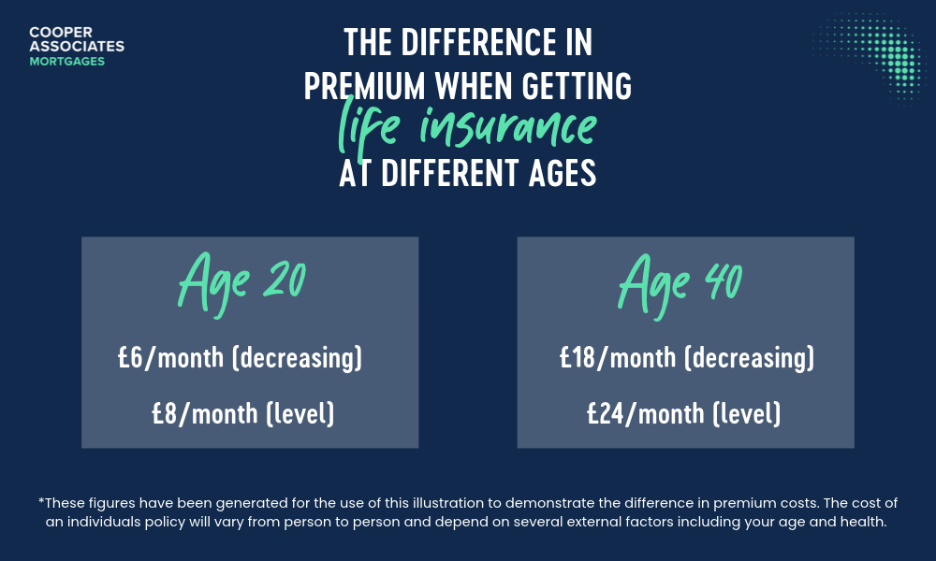
Below are some examples provided by Beth to demonstrate the importance of getting life insurance sooner rather than later to secure the most competitive price.
Decreasing term life insurance (typically used to protect a repayment mortgage):
“For a £250,000 decreasing term life insurance policy over 30 years, a healthy non-smoker aged 20 could expect to pay around £6 per month, while a healthy non-smoker aged 40 could expect to pay around £18 per month. That’s three times the monthly premium for the same level of mortgage protection, highlighting how taking out life insurance at a younger age can lead to significantly lower costs.”
Level term life insurance:
“For a £250,000 level term life insurance policy over 30 years, a healthy non-smoker aged 20 could expect to pay around £8 per month, compared with around £24 per month for a healthy non-smoker aged 40. Because the payout remains fixed throughout the policy term, level term cover is generally more expensive than decreasing cover, but the difference in cost between younger and older applicants remains significant.”
A real-life example: When two people couldn’t get life insurance
Our Mortgage and Protection Adviser, Beth Martin, explains:
“One case that highlights the importance of arranging protection early involved a couple buying a home together. There was a significant age gap between them, and the husband was self-employed and responsible for most of the household income.
He wanted to ensure his wife would be financially protected if he died before the mortgage was repaid, while also protecting himself against the potential loss of her income. However, both individuals had experienced serious health issues in the past and, despite approaching multiple providers, including specialist insurers, neither of them was able to secure life insurance cover.
Without protection in place, if either partner were to die, the surviving partner could face significant financial challenges, including keeping up with the mortgage repayments and everyday living costs. In the worst-case scenario, selling the property could become necessary if the surviving partner could no longer afford the mortgage repayments.
Had the couple arranged cover earlier, before their health circumstances changed, those policies may have remained in place and supported their current needs. Now they are doing what they can to ensure they are best prepared for the unexpected but lack the peace of mind that protection can provide.
This case is a reminder that you don’t need to predict the future before thinking about protection. Starting with cover that suits your circumstances today and reviewing it over time can make a real difference.”
What if my circumstances change after I take out life insurance?
You can review your cover to see whether it still gives you enough protection at any time during your policy and, depending on your circumstances, you can choose to replace your existing policy or take out additional cover.
Life circumstances can change quite significantly over time. You might move home, take on a bigger mortgage, have children or become responsible for someone else financially and when this happens, it is important to know that your cover can change with it.
Beth explains:
“Many insurers offer a Guaranteed Insurability Option (GIO), a feature that allows you to increase your life insurance cover following certain life events, such as getting married, having children, or taking on a larger mortgage, without needing further underwriting. This can help ensure your cover keeps pace with changes in your circumstances.
However, eligibility criteria, time limits and increase amounts will vary between lenders, so it is important to check the options available with your insurer.
Additionally, not all providers offer a GIO, and there may be limits on when and how much you can increase your cover by. If you happen to need additional protection and your provider cannot accommodate the change, you may need to submit a new application.
It’s also important to remember that your health at the time of any new application can affect your eligibility and the terms offered to you. If your health has changed and you no longer qualify for additional cover, your existing policy can usually remain in place.”
This is one of the reasons why arranging protection sooner rather than later can be beneficial. It allows you to put cover in place now and review it as your circumstances change over time.
How can Cooper Associates Mortgages help?
Nobody particularly enjoys thinking about what would happen if they died unexpectedly.
But taking out life insurance is not about expecting something bad to happen. It is about knowing that, if it did, the people who rely on you would not be left to deal with the financial consequences alone.
Our advisers can help you work out how much cover you may need, look at the options available to you and arrange protection that fits around your personal circumstances.
And as your life changes, your protection can change with it.
Some risks are best managed. Others are best insured. Life insurance can give you the reassurance that, if the worst happens, your family has a financial safety net to fall back on.
If you would like to explore the protection options available to you, our advisers are here to help you understand what may be appropriate for your circumstances. Get in touch today to arrange a no-obligation meeting.