
Overpayments can be a powerful, yet often overlooked, way to reduce the overall cost of your mortgage. If you have extra disposable income available, making additional payments towards your mortgage may not seem like an obvious choice, but may offer an effective way to minimise interest payments in the long-term.
In this article, we explore the potential benefits and considerations of making mortgage overpayments, helping you understand when they may be appropriate and how they could fit into your long-term financial plans.
What are mortgage overpayments?
When you take out a mortgage, the money you borrow is known as the capital. Your mortgage lender will charge interest on the capital borrowed, which increases the overall cost of buying your home.
For example:
If you purchase a property for £200,000 with a 5% deposit (£10,000), you will borrow £190,000 (your mortgage).
Assuming a 25-year term, an interest rate of 5.00% and no overpayments being made, the total amount repaid over the full term would be approximately £333,216. Meaning around £143,216 in interest would be paid on top of the original loan amount.
For repayment mortgages, your monthly payments are calculated to ensure the loan and interest are repaid over the agreed mortgage term.
Mortgage overpayments refer to paying back more than the required amount towards your outstanding balance, either through regular additional payments, a lump sum, or a combination of both. By reducing the outstanding balance sooner, you may be able to shorten your mortgage term and lower the total amount of interest paid over time.
Why should I consider overpaying on my mortgage?
There are several benefits to making overpayments on your mortgage, with the most significant one being that you will clear your outstanding balance much quicker.
As interest is charged on the remaining balance, lowering this amount sooner can reduce the total interest paid over the life of the mortgage. In some situations, using spare savings to make overpayments may be financially beneficial in the long-term.
For example, if your savings are held in an account that earns 5.00% interest, but your mortgage rate is 6.00%, the interest you are paying on your mortgage is higher than the return you are receiving on your savings. In this scenario, directing some funds towards your mortgage may be a more efficient use of your money.
Additionally, overpayments can also increase the level of equity you hold in your property, which improves your loan-to-value (LTV) ratio. This can be beneficial as a lower LTV generally reduces the level of risk for lenders, which may help you access more competitive rates when you remortgage.
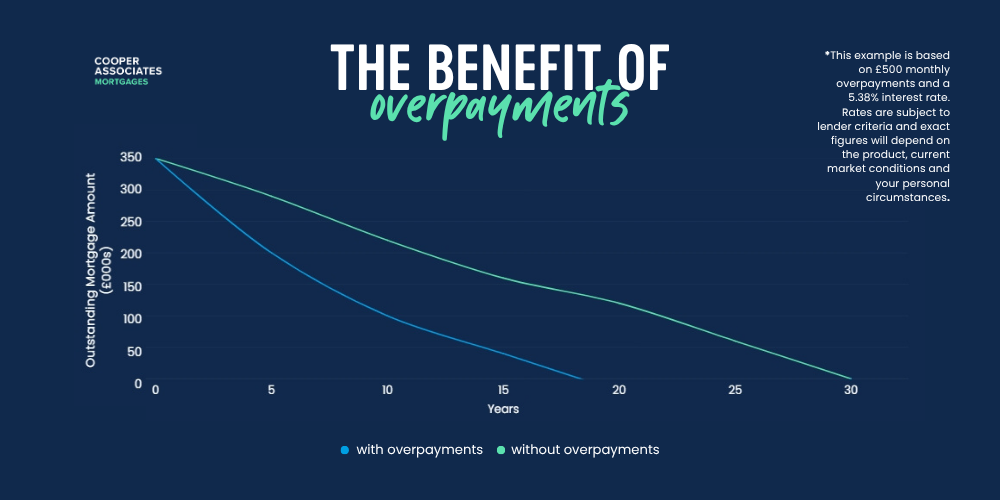
For example:
If you take out a £350,000 mortgage over 30 years at an interest rate of 5.38% and choose to overpay by £500 per month, you could reduce the total interest paid by approximately £147,360 and repay the mortgage 11 years and 1 month earlier.
What should I consider before overpaying my mortgage?
While mortgage overpayments can offer long-term benefits, it is important to consider how they align within your wider financial position before committing additional funds. Key considerations include:
1. Ensuring you maintain sufficient savings.
Before making any overpayments, it is sensible to ensure you have sufficient savings in place. Allocating too much of your available cash towards your mortgage could leave you with limited financial flexibility if unexpected expenses were to arise.
Once an overpayment has been made those funds are normally no longer easily accessible. Accessing those funds would typically require remortgaging or applying for a further advance, which may not always be straightforward or suitable depending on your circumstances at the time.
Taking a considered approach can help ensure that any overpayments made are affordable and do not impact your ability to manage short-term financial commitments.
2. Reviewing any higher-interest financial commitments.
It may be more beneficial to first prioritise the repayment of other higher-interest financial commitments, such as credit cards, overdrafts, or car finances, before considering mortgage overpayments. These products often carry significantly higher rates than mortgages, meaning paying these commitments down first could be a more effective way to reduce your overall borrowing costs.
3. Understanding your lender’s overpayment limits.
Mortgage lenders typically allow you to overpay up to 10% of your outstanding mortgage balance each year without incurring a charge. Exceeding this limit may trigger early repayment charges (ERCs), which could make large overpayments less cost-effective. Therefore, checking the specific terms of your mortgage agreement prior to making additional payments is essential to avoid these potential fees.
Should I overpay my mortgage or reduce the term?
If your goal is to repay your mortgage sooner, there are two common approaches to achieving this: making voluntary overpayments or reducing your mortgage term when arranging a new deal.
Reducing your mortgage term
Reducing your mortgage term means your loan is repaid over a short period of time, which increases your monthly repayments but reduces the amount of interest that can build up over time. As a result, this approach can lead to significant long-term interest savings.
However, committing to a shorter mortgage term involves locking into higher monthly repayments that typically cannot be reduced without remortgaging. Due to this, it is important to consider that if your financial circumstances change due to unforeseen circumstances, it may be more challenging to repay your mortgage.
Making voluntary overpayments
In contrast, choosing to make overpayments on your current mortgage deal can offer greater flexibility as the size and frequency of overpayments are optional (provided you do not exceed the lenders overpayment threshold).
This flexibility can help you reduce your mortgage balance sooner and without committing to higher monthly payments, which may help manage financial risk if your income or circumstances were to unexpectedly change.
How much can I overpay on my mortgage?
Most mortgage lenders set a limit on how much you can overpay each year without incurring a charge. During this time, you may be subject to early repayment charges (ERCs) if you decide to remortgage early or exceed the overpayment threshold.
Most lenders typically allow borrowers to overpay up to 10% of their outstanding mortgage balance each year without penalty. However, this threshold may vary depending on the lender and mortgage product.
It is important to consider that if you exceed the permitted limit, you may face an ERC, which could reduce or outweigh the potential savings from making an overpayment.
Why is there a limit on overpayments?
Overpayment limits exist because mortgage agreements are typically structured around the interest a lender expects to receive over the agreed mortgage term.
By making large or regular overpayments you are likely to pay off your mortgage sooner. This means the lender may lose some of their expected profit gained from the interest. Early repayment charges (ERCs) therefore help protect lenders from this potential loss if repayments were to exceed the permitted overpayment threshold.
Should I make regular or a lump sum mortgage overpayment?
Both regular and lump sum overpayments can help reduce your outstanding mortgage balance, which may lower the amount of interest you pay and help reduce your mortgage term. However, the most suitable approach will depend on your financial circumstances and how you prefer to manage your cash flow.
Lump sum overpayments
Making one-off lump sum overpayments can immediately reduce your mortgage balance, meaning interest is calculated on a smaller amount from that point onwards. This can accelerate interest savings and improve your loan-to-value (LTV) ratio quicker.
Regular overpayments
In contrast, regular overpayments (e.g. monthly) gradually reduce your balance over time, but can still result in meaningful interest savings and a shorter mortgage term. For many borrowers, this approach can be easier to manage alongside other financial commitments and offers greater flexibility if your financial circumstances were to change.
Maintaining financial flexibility
Before making a large lump sum overpayment, it is important to consider your wider financial position. Once these funds have been used to reduce your mortgage balance, they may not be easily accessible if you suddenly require them later. Maintaining an emergency savings fund can help ensure you retain financial security and flexibility while making overpayments.
How can Cooper Associates Mortgages help?
Before making mortgage overpayments, it is important to consider your wider financial position. Ensuring you have sufficient savings in place to cover unexpected expenses and that higher-priority financial commitments have been addressed can help protect your financial stability.
If you are considering making overpayments and would like further guidance, our award-winning mortgage advisers are here to support you. We can review your current mortgage, discuss your available options, and provide tailored advice to help you decide whether overpayments are the right approach for your personal circumstances.
You can also explore the potential impact of overpayments using our mortgage calculator, which allows you to see how additional payments may affect your mortgage balance and term.
To book a fee-free, no-obligation consultation, get in touch today and learn how Cooper Associates Mortgages can support you throughout your homeownership journey.