
For many individuals looking to buy their first home, remortgage to a better deal, make extra repayments to save on interest or even pay off their mortgage entirely, Early Repayment Charges (ERCs) can be a confusing concept as they vary from product to product.
In this article we break down what ERCs are, how they work, why they are put in place by lenders, and tips on how to minimise their impact.
What is an Early Repayment Charge (ERC)?
An Early Repayment Charge (ERC) is a fee you may incur if you exit your current mortgage deal before the agreed end date or pay off the final balance early. You may also be required to pay an ERC if you make regular overpayments on your mortgage that exceed your annual penalty free allowance set by the lender.
ERCs are often calculated as a percentage of your outstanding mortgage balance and typically vary between 1% and 5%. ERCs can taper over time, although some will remain at the same rate for the duration of your mortgage product, particularly for your shorter term products arranged over two to three years.
ERCs are set by the mortgage lender and act as a form of financial protection for them. This is important as the lender has priced having interest on the amount borrowed for the duration of the product given to the borrower. If the borrower then decides to leave early or pay off their mortgage early (impacting the interest the lender will receive) this will have a direct impact on the lender.
You may be charged an ERC if you do the following:
- Sell your property and pay off the mortgage early (before the agreed product term ends).
- Remortgage to a new deal before your current product term ends.
- Decide to clear your mortgage in full (e.g. after receiving an unexpected cash lump sum such as inheritance).
- Make a lump sum overpayment that exceeds your annual penalty-free allowance.
- Make regular (monthly/recurring) overpayments that exceed your annual penalty-free allowance.
How do ERCs work?
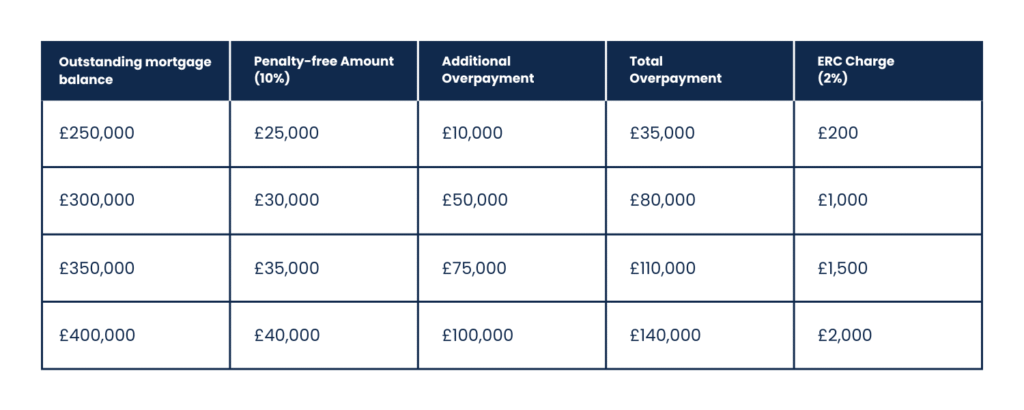
Mortgage lenders calculate the ERC applicable based on the amount being paid over and above the allowance agreed as part of your mortgage deal.
For most mortgage products, an allowance of 10% of your outstanding mortgage balance is usual. For those with an offset mortgage, however, overpayments are unlimited providing you leave a nominal balance on your mortgage account.
If you overpay more than 10%, you will be charged an Early Repayment Charge on the excess amount as you would have exceeded your penalty-free allowance.
The chart below showcases how Early Repayment Charges will vary depending on the outstanding mortgage balance, penalty free amount and your additional overpayment, calculated with a 2% ERC.
Which mortgage products have an ERC applied?
Fixed-rate mortgages
Longer-term fixed-rate mortgage products usually have a tapering ERC, meaning the fee decreases over time as the loan progresses. For example, a five-year fixed product might have an ERC of 5% in the first year, reducing by 1% each year until it reaches 1% in the final year.
In contrast, shorter-term fixed products (two to three years) tend to have a flat ERC, often set around 3% throughout the fixed period. This difference reflects the lender’s need to balance pricing and risk over varying product durations.
Standard variable rate mortgages
Standard Variable Rate (SVR) mortgages offer flexibility, as most allow you to make unlimited overpayments without early repayment charges (ERCs). This can be particularly useful if you’re expecting a significant life change, as you can remortgage or repay your loan at any time without exit fees.
Each lender sets their own SVR, which is typically the rate your mortgage will move to once your fixed or tracker deal ends. However, SVR rates are often higher than other types of mortgages, so your monthly payments could increase.
It’s also worth noting that SVRs can change at your lender’s discretion, meaning they can rise or fall at any time. For this reason, it’s always important to review the terms carefully before proceeding, as rates and conditions vary between lenders.
Tracker mortgages
Tracker mortgages move in line with an external rate, most commonly the Bank of England’s (BoE) base rate plus a set percentage determined by your lender.
This means your interest rate, and therefore your monthly payments, will rise or fall with changes to the base rate.
Some lenders offer tracker mortgages with no early repayment charges (ERCs), giving you added flexibility to switch or repay your mortgage at any time.
However, if interest rates increase, your payments will also rise, so it’s important to consider how comfortable you are with potential rate changes.
Discounted-rate mortgages
Discounted Rate Mortgages are similar to Standard Variable Rate (SVR) mortgages, but with a temporary discount on the lender’s SVR for a set period, often as an introductory offer. For example, a lender might provide a 1% discount on their SVR for the first two years of your mortgage.
This discount means your initial monthly payments are likely to be lower. However, once the discount period ends, your rate will revert to the lender’s standard variable rate, which may be higher.
It’s also important to note that early repayment charges (ERCs) often apply during the discount period, making these mortgages less flexible than SVRs.
How do I know if an ERC applies to me?
Before you take out a mortgage, the lender should supply you with a European Standardised Information Sheet (ESIS); a formal, personalised breakdown of your mortgage offer. It will provide you with key information about the mortgage you are considering, including costs, features and conditions.
This document is essential as it should also clearly outline if an ERC applies to you, how your charges will be structured, and how long the ERC lasts (they may reduce over time), which will enable you to make an informed decision before applying.
Why do lenders apply an ERC?
When you take out a mortgage, your lender calculates the interest they expect to earn over the full term of your loan. If you repay your mortgage early, the lender receives less interest than planned, as your outstanding balance reduces sooner than expected.
Early repayment charges are designed to help lenders recover some of that lost income. They also cover any financial costs the lender may face, as many borrow funds themselves to provide your mortgage and expect repayment over a set period. If you repay early, they may need to adjust or unwind that funding, which can incur costs.
ERCs also discourage frequent switching between lenders purely to secure short-term deals. This helps maintain more stable, predictable relationships between borrowers and lenders, while ensuring lenders are fairly compensated if you decide to overpay or remortgage before the end of your agreed term.
How do I avoid paying an ERC?
The easiest way to avoid early repayment charges (ERCs) is to wait until the ERC period expires before repaying your mortgage or switching deals. For most fixed-term mortgages, this is usually at the end of your agreed term.
Overpayments can be a prudent way to reduce the interest you pay over time. However, it’s important to monitor your overpayments carefully to ensure you stay within your lender’s overpayment allowance and avoid triggering an ERC.
If you’re moving home, ask your lender or adviser about porting your mortgage. Porting allows you to move your existing mortgage, including the current deal and interest rate, to a new property. For fixed-term mortgages, porting can help you maintain your rate and avoid ERCs.
If flexibility is important to you, or you anticipate changes such as a growing family, career promotion, or relocation before your mortgage deal ends, it’s essential to consider ERCs when choosing a product.
For instance, if you plan to overpay, sell your home, or move to a new property, it may be worth speaking to one of your lender or mortgage advisers. They can help you find a mortgage with low or no ERCs, even if that means accepting a slightly higher interest rate initially, to better suit your circumstances.
Are there benefits to making an early repayment?
Making regular mortgage repayments is highly beneficial, reducing your balance, saving you interest over time, and increasing your equity in the property.
However, ERCs can be costly if your repayments exceed your penalty-free allowance (usually 10% of the mortgage balance) so it’s important to weigh the cost of the charge against any potential long-term savings before making extra repayments.
For instance, if you have a high-interest mortgage, it may be more cost-effective to pay the ERC and switch to a better deal. Similarly, if your circumstances change, such as wanting to move from a fixed-rate mortgage to a variable-rate mortgage for greater flexibility, paying an ERC could still be worthwhile in the long run.
Tip:
If you are considering paying off your mortgage in full, you can request a redemption statement from your lender. This will show you the exact outstanding balance of your mortgage, any early repayment charges, and daily interest accrual.
Ultimately, your decision depends on your personal circumstances and speaking with a mortgage adviser will be beneficial in determining what product is right for you.
How can Cooper Associates Mortgages help?
Whether you’re buying your first home, remortgaging, or exploring all the options available to you, the Cooper Associates Mortgages team is here to help.
Our advisers provide whole-of-market, expert advice tailored to your personal circumstances and financial goals. They are committed to helping you navigate your mortgage journey with confidence, ensuring you understand every step along the way.
Best of all, our service is completely fee-free.
To see how our specialist mortgage advisers can support you, get in touch today and start your journey with Cooper Associates Mortgages.